

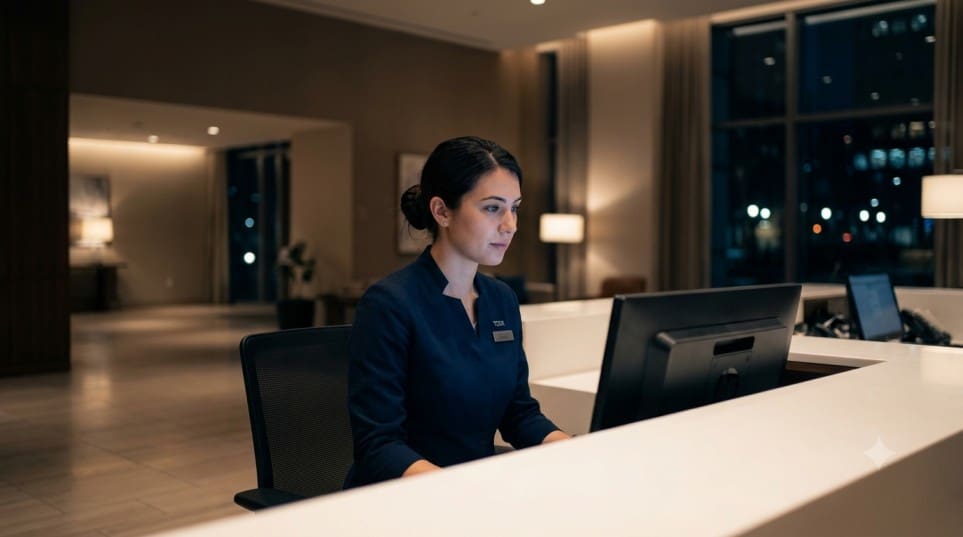
A guest arrives at 1:47 a.m. Her flight was delayed twice, the connection was missed, and the last leg required a rental car from an unfamiliar airport. By the time she walks into the lobby, the person at the front desk is the night auditor, halfway through reconciling the day’s transactions. He has been the only staff member on the property since 11 p.m. After a warm greeting and a quick check-in, he returns to the audit. Twenty minutes later, another guest calls from her room about a leaky faucet. Now the night auditor has to decide which of the three responsibilities competing for his attention comes first. That is the operational shape of overnight guest service in most independently operated hotels I have advised across the Northeast. It is a coverage gap that most properties have chosen not to examine closely.
The gap is not accidental. Overnight staffing is expensive. Occupancy at those hours is unpredictable. And the traditional night auditor role bundles guest service and back-office reconciliation into a single position. That position was never designed to do either well when both demand attention simultaneously. Closing that gap without doubling the overnight payroll is where a serious hospitality call center outsourcing partner earns its keep. A nearshore support team running through the overnight window can absorb the guest calls that currently interrupt the night auditor. That reshapes the coverage model into something that actually works. This piece walks through where the gap opens, what it costs, and how to rebuild the coverage.
- Why Overnight Guest Service Falls to Whoever Happens to Be Awake?
- What Standard Overnight Guest Service Actually Fails to Deliver Consistently
- How Overnight Guest Service Breaks Down in Real Independent Hotel Operations
- The Real Cost Behind Poor Overnight Guest Service in Modern Hospitality
- How to Rebuild Overnight Guest Service Without Adding On-Property Staff
- Frequently Asked Questions About Overnight Guest Service Operations
Why Overnight Guest Service Falls to Whoever Happens to Be Awake?
The overnight staffing model at most independent hotels was built for a quieter era. The single night auditor covered a lobby that saw maybe three arrivals between 11 p.m. and 6 a.m. They handled the occasional room service call or wake-up request in between. The reconciliation work fit into the quiet windows. The guest-facing work fit into the busier ones. When the guest volume was low enough, the model actually worked. The problem is that guest expectations have evolved faster than the staffing model. Evenings that were quiet in 2015 are now interrupted by delayed flights, ride-share arrivals at unpredictable hours, and business travelers working on laptops from the room until 2 a.m.
The night auditor role has quietly expanded. Industry analysis of the hotel night audit function documents that the position now combines guest services, security response, exception review, and financial reconciliation. All into a single seat that typically runs from 11 p.m. to 7 a.m. Any surge in guest activity defers the reconciliation. Any surge in reconciliation complexity defers the guest work. The role is inherently overloaded whenever both channels are active.
This ties into how customer support bottlenecks develop when systems treat parallel work as sequential. The night auditor is exactly the case where two parallel workflows are treated as if a single person could handle them sequentially. The math does not work when both channels are active, and the guest is the one who feels the mismatch first.
What Standard Overnight Guest Service Actually Fails to Deliver Consistently
The standard model fails on three specific dimensions. Response time on phone calls is the first. A guest calling from her room at 2:14 a.m. about a maintenance issue or a request for extra towels often gets voicemail or a delayed response. The single overnight staffer may be handling a check-in or working the audit at that moment. Eventually, the response comes through, but the guest experience has already been shaped by the wait. Her review the next day reflects that delay as much as the resolution.
Late arrivals create a second weakness: engagement quality. Someone arriving at 1:47 a.m. after a difficult day of travel wants a warm welcome, clear directions to the room, and a sense that the property recognizes she is tired. Instead, the interaction may be a functional check-in delivered by a staffer mentally partway through a spreadsheet task. Polite service is still service, but it can feel thin. At that hour, the difference between a warm arrival and a functional one can separate a five-star review from a three-star one.
Exception handling becomes the third pressure point. When something genuinely goes wrong overnight, whether it is a fire alarm, a medical situation, or a security concern, the single overnight staffer has to manage the exception while keeping routine work moving. Most properties do not have an escalation path that functions at 3 a.m. As a result, the overnight staffer improvises. Sometimes that improvisation goes well. Other times, it becomes the incident that creates a legal or reputational problem for the property the next morning. Overnight guest service without a reliable exception escalation path is one of the quieter operational risks in independent hospitality.
How Overnight Guest Service Breaks Down in Real Independent Hotel Operations
The breakdown pattern is consistent across the properties I have advised. It follows a predictable cadence. Stage one is the pre-midnight window, from roughly 11 p.m. to 1 a.m. The night auditor arrives, receives handoff from the evening shift, and begins reconciliation. Occasionally a late arrival needs checking in. The workload is manageable. The guest experience is generally good. The auditor has bandwidth to actually engage.
Stage two is the deep overnight window, roughly 1 a.m. to 4 a.m. This is when the audit work is heaviest. It is also when the last of the delayed-flight arrivals show up. The night auditor is now genuinely stretched. The tradeoffs start to bite. Every check-in interrupts the audit. Every audit step defers the check-in. The guest experience quality drops. Most guests do not have the comparison to know it. Stage three is the pre-dawn window, roughly 4 a.m. to 7 a.m. The audit is closing out. Wake-up calls are starting. Early departures for airport flights are beginning. The overnight staffer is now working through the closeout while managing an outbound guest flow. The handoff to the morning shift is often incomplete because the audit had to be prioritized.
More than half of surveyed hotels remain understaffed heading into 2026, even after 70 percent of properties raised wages and 54 percent added flexible scheduling. That staffing pressure continues to shape hotel operations. In that labor market, adding a second overnight staffer at an on-property wage is often infeasible. Many properties have simply accepted the coverage gap as a structural feature.
The Real Cost Behind Poor Overnight Guest Service in Modern Hospitality
The cost lands in four places. The measured cost is guest satisfaction on overnight interactions, if the property tracks it separately from daytime interactions. Most properties do not. The overnight friction gets averaged into the aggregate satisfaction score and never becomes a visible driver. The three unmeasured costs are usually larger. First, the reviews. Guests who had a poor overnight interaction, especially arriving late-night guests, tend to remember. They mention the arrival experience in their reviews. That public sentiment shapes future booking decisions.
Second, the audit quality. When reconciliation work gets frequently interrupted by guest interactions, the error rate rises. Those errors surface as morning discrepancies the daytime team has to investigate. The aggregate hours spent on audit correction across a year add up. That number never gets attributed to the coverage gap. Third, the overnight staffer turnover. Night auditors working an overloaded role burn out faster than staffers in properly resourced positions. The recruit-and-ramp cost of replacing a night auditor in a tight labor market is substantial. This ties into how measuring service performance effectively requires metrics that reflect operational reality. The overnight period is exactly the case where standard measurement hides the aggregate cost.
How to Rebuild Overnight Guest Service Without Adding On-Property Staff
The rebuild works in three moves. The first is to separate guest phone service from on-property presence. Most guest calls between 11 p.m. and 6 a.m. are questions or routine requests. They do not actually require the person to be inside the building. A nearshore support team dedicated to overnight hospitality coverage can absorb those calls. It can answer them warmly and professionally. It can dispatch on-property action only when actually needed. This removes the interruption from the night auditor. It gives the guest a faster response than the current model produces.
The third move is measurement. Once the model is redesigned, track the overnight metrics separately. Response time on phone requests. Guest satisfaction on late arrivals. Audit accuracy. Exception response time. When those four metrics all move together, the redesign is working. A specialist nearshore hospitality support team providing overnight phone coverage, with the on-property night staffer refocused on presence-required work, is the fastest way to close the coverage gap without adding on-property payroll. Serious independent operators across the Northeast have been quietly implementing this. Competitors continue to let overnight staffers drown in an overloaded role every night.
| Rebuilding your overnight coverage? More coverage at the Lab. The Customer Experience Lab publishes ongoing analysis of hospitality operations, overnight staffing models, and the specific choices that decide whether a late arrival gets welcomed or waits at an empty desk. Same evidence-based approach as this piece, aimed at operations leaders working with real staffing constraints and real guest expectations. Bookmark it if this article gave you something to work with. Visit The Customer Experience Lab |
Frequently Asked Questions About Overnight Guest Service Operations
1. What is overnight guest service?
It is the operational coverage a hotel provides to guests during the overnight window, typically from 11 p.m. to 7 a.m. Most independent properties assign this to a single night auditor who combines guest service with financial reconciliation, which produces a structurally overloaded role when both channels are active at the same time.
2. Why does overnight service fall through the cracks?
Four costs. Measured guest satisfaction on overnight interactions, if tracked separately. Public reviews from guests who had thin arrival experiences. Audit error rates that create morning discrepancies. And higher turnover among overnight staffers burning out in an overloaded role. Only the first is usually measured, and the other three tend to be larger in aggregate.
3. Why does adding a second on-property overnight staffer rarely work?
Because the labor market makes adding overnight coverage at an on-property wage infeasible for most independent properties, especially in a period where more than half of surveyed hotels report continued understaffing. The economics of on-property overnight staffing have shifted, and most operators have accepted the gap rather than doubling the overnight payroll.
4. What is the fastest way to close the overnight coverage gap?
Separate guest phone service from on-property presence by routing overnight calls to a specialized nearshore hospitality support team. Redesign the on-property role around functions that genuinely require presence: late arrivals and exception response. Track overnight metrics separately so the redesign impact can be measured. This closes the gap without adding on-property payroll.
5. What does poor overnight guest service actually cost?
Four costs. Measured guest satisfaction on overnight interactions, if tracked separately. Public reviews from guests who had thin arrival experiences. Audit error rates that create morning discrepancies. And higher turnover among overnight staffers burning out in an overloaded role. Only the first is usually measured, and the other three tend to be larger in aggregate.