
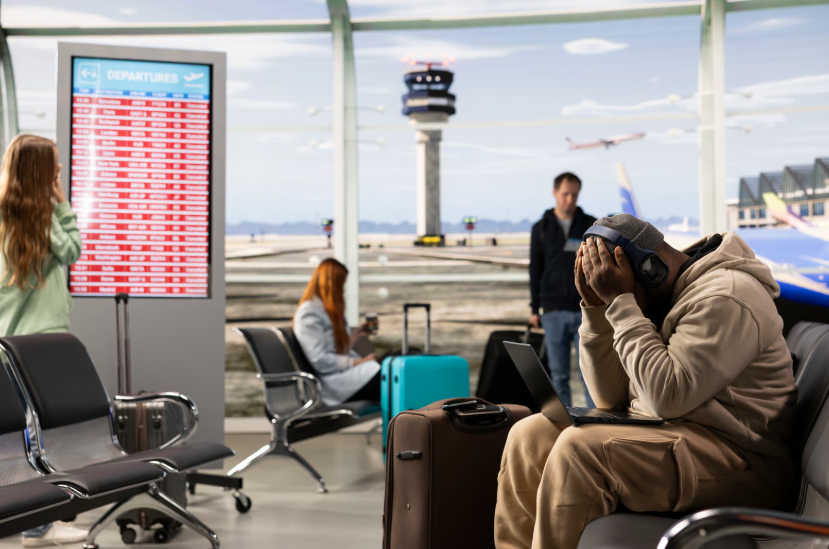
A cancellation is not the event customers remember. What they remember is the ninety minutes afterward — whether anyone told them what was happening, whether the person who answered could actually move them, and whether the seat they ended up in was the best available or just the first one found. Travel disruption rebooking is the operational discipline that decides which of those versions the passenger gets, and most operations design it after the first bad week rather than before.
The scale is not exceptional anymore. It is the baseline.
What Travel Disruption Rebooking Has to Solve at Once
Three problems arrive simultaneously and compete for the same resources: volume that spikes from baseline to peak in under an hour, an inventory problem where the available seats are fewer than the displaced passengers, and a communication problem where silence is read as indifference.
The industry backdrop makes the frequency clear. The Bureau of Transportation Statistics counts a flight as on time when it arrives within fifteen minutes of schedule — a generous definition by any customer’s standard. Against that bar, analysis of BTS data published in July 2026 put average on-time performance for major US carriers at 76.42% across 2025, down from just over 78% in 2024, with the January-to-May 2026 figure at 76.78%.
Volume follows from that. PIRG’s Plane Truth 2025 analysis reported that roughly 1.7 million flights were delayed or canceled in 2024 out of 7.5 million scheduled by the top ten airlines and their marketing partners, with on-time arrivals across all US carriers at 77.9%.
Roughly one in four flights is a service event waiting to happen. An operation treating rebooking as exception handling is planning for a condition that no longer exists.
Before the Passenger Calls: The First Fifteen Minutes
The largest lever in the playbook sits before any contact arrives. Every passenger who is rebooked proactively and notified is a passenger who does not enter the queue, and queue volume is the constraint that breaks everything else.
That requires three things in place ahead of the event. Contact preferences captured at booking and kept current. A notification path that does not depend on the passenger opening an app. And a default rebooking rule the system can execute without a human decision — next available flight, same carrier, protected connection.
The default will be wrong for a meaningful share of passengers. That is acceptable. A wrong automatic rebooking that the passenger can change is a far better starting position than no rebooking and a forty-minute hold.
During the Surge: Triage, Authority, Inventory
Once contacts arrive, the operation is rationing two scarce things: agent minutes and seats. Most teams ration both badly, by handling contacts in arrival order.
| Passenger situation | Why order matters | Handling |
|---|---|---|
| Connection at risk, still in the air | Window closes on its own | Rebook before landing; notify at the gate |
| Stranded overnight, no accommodation | Cost and goodwill both compound hourly | Highest agent priority; accommodation authority required |
| Multi-carrier or partner itinerary | Cannot be solved in one system | Route to agents with interline access, never to general queue |
| Flexible traveler, later departure | Absorbs the least value from immediate handling | Self-service path with a callback option |
The second column is the whole argument. Triage by decay rate, not by arrival time.
Agent authority is the other half. An agent who must escalate to waive a fare difference, authorize a hotel, or book onto another carrier is not resolving anything — they are collecting information for someone who can. The alternative to a fast decision is a passenger making their own arrangements and disputing the cost later.
Worth knowing what the competitive floor looks like: the PIRG analysis of the Department of Transportation’s airline customer service commitments noted that all ten major carriers pledge to rebook on their own airline and provide a meal voucher, while six of the ten will rebook a passenger on a competitor. Passengers increasingly know which category their carrier falls into.
Staffing a Curve That Has No Warning

Surge capacity is where the operating model gets decided, because the demand shape is hostile to fixed staffing. A hub weather event produces demand that arrives in under an hour and disappears in a day: a team sized for it sits idle most of the year, and a team sized for normal volume is useless when it matters.
The realistic options for travel disruption rebooking capacity are an on-call internal reserve, cross-trained staff pulled from adjacent queues, or contracted surge capacity through a travel bpo services arrangement where the partner holds trained headcount that can be activated against a defined trigger. The tradeoff in the third case is preparation debt: an outsourced team that has not been trained on the fare rules and interline procedures before the event will not help during it.
This is the same structural point behind analysis of why travel support cannot be run on static staffing models — the demand curve, not the headcount, is what has to be designed around.
After the Recovery: What Gets Reviewed
Most operations debrief the cause of the disruption, which is usually weather and therefore not actionable. The reviewable material is the recovery.
- Time to first notification. Measured from the operational decision, not from the passenger’s call
- Rebooking quality. How many passengers changed the assigned itinerary afterward, which measures whether the default was any good
Systems capability sets the ceiling on all four, a dependency covered in analysis of how digital operations reshape travel service delivery. The playbook is only as fast as the tooling that executes it.
FAQ: Travel Disruption Rebooking: The Operational Playbook
1. What is travel disruption rebooking?
It is the operational process of reaccommodating passengers whose itineraries are broken by a delay, cancellation, or diversion. It combines automated reassignment, prioritized agent handling, and proactive communication, and is typically the largest single driver of customer perception during an irregular operations event.
2. How quickly should passengers be notified after a cancellation?
As soon as the operational decision is made, not when the rebooking is finalized. Passengers tolerate an incomplete update far better than silence, and early notification also reduces the inbound contact volume competing for agent time.
3. Should rebooking be automated or handled by agents?
Both, in sequence. Automation should apply a default reaccommodation to every affected passenger immediately; agents should handle the exceptions — partner itineraries, accommodation, accessibility needs, and anyone the default served badly.
4. How should agents prioritize during a large disruption?
By how fast each situation deteriorates rather than by contact order. Passengers with connections still in the air and passengers facing an unplanned overnight lose the most value per hour of delay in handling.
5. What metrics indicate a disruption was handled well?
Proactive rebooking rate, time from operational decision to first passenger notification, and the share of automatically assigned itineraries that passengers later changed. Cause analysis of the disruption itself rarely produces anything actionable.